The heart and soul of the message of the Bible is the forgiveness of sins. A good way to understand that message is to know the history behind it. Many Christians refer to the Bible as the history of salvation. Salvation history is the history of what God has done to save us from our sin. The first time God announced his forgiveness of sins was immediately following the first sin. However, we must first understand how that first sin came about. That first sin came about because Adam and Eve were deceived by someone who hated them, the world, and God very much. That someone is Satan.
Satan Tempts Adam and Eve
Satan is called many names in the Bible, and each name is pretty fitting. The name Satan itself means “adversary,” and describes how he works against God and God’s people (Acts 26:17-18; 2 Corinthians 2:10-11). He is also called the devil, which means “accuser” or “slanderer.” This name illustrates how he stands before God and accuses people of their sin (Job 1:6-11; 2:1-4; Zechariah 3:1). Jesus referred to him many times as “the evil one,” pointing out how everything Satan does is the opposite of the good that God loves (John 17:15). Jesus also called him “the father of lies” (John 8:44) because he has been lying about the love of God from the very beginning—from the time he first appeared to Adam and Eve. God told Adam and Eve they would die if they sinned, but Satan lied and told them it wasn’t true. He made them doubt God’s love, and because of this they brought death into the world by sinning against God (Genesis 3:1-13).
The Promise of a Savior
“And I will put enmity between you and the woman, and between your offspring and hers; he will crush your head, and you will strike his heel.”
Genesis 3:15, the first promise of a Savior
That’s when God confronted their sin and gave them the first promise of a Savior. God told Satan, “I will put enmity between you and the woman, and between your offspring and hers; he will crush your head, and you will strike his heel” (Genesis 3:15—the word “enmity” means hostility). With these words, God was telling Satan that the coming Savior (the offspring, or “seed”—see Galatians 3:19) would fight against him and the results of his evil work, the sins that would come from deceiving Adam and Eve. God was also telling everyone how that fight would end. The sins Satan had caused would make the Savior suffer (“you will strike his heel”), but because the Savior would suffer for those sins it would mean he would ultimately triumph over Satan (“he will crush your head”) for the sake of mankind.
Many years later, God began his work of bringing that Savior into the world. He chose a man named Abraham to be the father of a “great nation.” He also told him the future Savior would come from this great nation and his family line, telling him, “All peoples on earth will be blessed through you” (Genesis 12:3). Eventually, the nation that grew from Abraham’s line became known as the nation of Israel, also called the Hebrews and eventually the Jews. For roughly 2000 years, the people from Abraham’s line were guided by leaders and prophets chosen by God to keep them on the path toward the coming Savior (see the Timeline of Salvation History). Those years included some high points for Israel. They also included many low points. But whether the times were good or bad, through the Israelites God still preserved his Word and the hope of his promise.
God’s Law as a Shadow of the Coming Savior
One of the ways God preserved that hope was by giving the Israelites his law. God’s law was a gift given to teach his people how to live God-pleasing lives. This law contained guidelines for morality, a peaceful society, and foreign relations. Every part of the law was meant to keep God’s people as his people instead of losing them to the false gods of the Gentiles, the non-Jews. It was also meant to show the Israelites their sin and their need for the coming Savior. The whole purpose of the law was to remind the Israelites that God chose them to bring the much needed Savior into the world.
That can be seen in the many laws God gave the Israelites involving the ritual sacrifice of animals and plant foods. The act of sacrificing had already been around since the time of Adam and Eve’s children (Genesis 4:3-5), but here with Israel God gave specific instructions for sacrifices. Two types of sacrifices, called Sin and Guilt offerings, had to be offered as a way of atoning for sin. Atonement is a word used to describe the healing of a relationship (think “at-one ment”). God was showing his people that because of sin our relationship with him needed to be repaired and that a sacrifice of atonement was the only way to repair it (Leviticus 4:20, 26, 31, 35; 5:10, 13, 16, 18; 6:7). Other sacrifices were offered to thank God for his mercy and care, celebrating that restored relationship with him.
“These are a shadow of the things that were to come; the reality, however, is found in Christ.”
Colossians 2:17
This whole system of offering sacrifices to God was a picture that pointed forward to the coming Savior. God was showing his people that the Savior would once and for all atone for the sin of the world (Hebrews 10:1-18). The fact that the animal had to die in place of the person pointed forward to the death of the Savior in place of all people (Romans 3:25). The animals offered for atonement had to be “without blemish,” which pointed forward to the perfect life the Savior had to live (Romans 5:19; 1 Peter 1:18-20). God was also showing us that our sins had to be atoned for with blood, as he explains in his Word, “Without the shedding of blood there is no forgiveness” (Hebrews 9:22). With these sacrifices, God was revealing to everyone the Savior was going to live a perfect life and then offer his life and blood as a sacrifice of atonement for all people.
The Savior Jesus Arrives
At the proper time, the Savior and “Seed” of Eve came into the world. Jesus came and fulfilled everything God had foretold about the coming Savior, including his life of perfectly following the law. He was born of a virgin woman and conceived by the Holy Spirit (Luke 1:34-35), which means he didn’t have a sinful nature. He was tempted by sin and Satan just like Adam and Eve and all people, but he resisted temptation and never sinned (Matthew 4:1-11; Mark 1:12-13; Luke 4:1-13). The men who were trying to have Jesus killed couldn’t accuse him of doing anything wrong, so they had to lie (Matthew 26:59-60). And because he was perfect, Peter called him “a lamb without blemish or defect” (1 Peter 1:19), the one who was worthy of atoning for our sins.
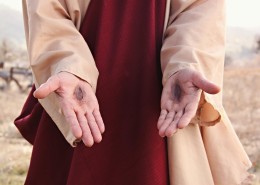
After a life of perfectly following God’s will, Jesus finally offered his life as our sacrifice of atonement. He suffered the punishment that our sins deserved. As the prophet Isaiah said, “He was pierced for our transgressions, he was crushed for our iniquities; the punishment that brought us peace was upon him, and by his wounds we are healed” (Isaiah 53:5). A transgression is a violation of a law, and it’s another word for a sin. Jesus died in our place the same way a sacrificial animal died in place of an Israelite according to God’s law.
Jesus, Our Substitute
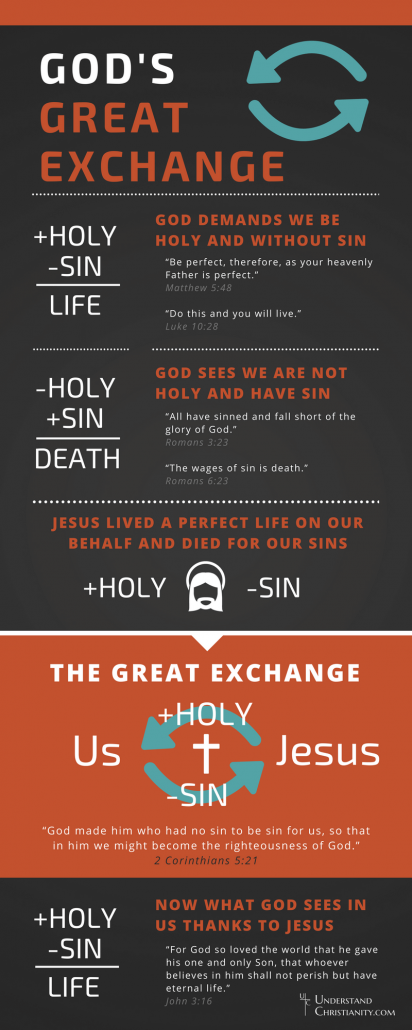
Why did he, as the atoning sacrifice, have to be perfect? It all has to do with his life and his death being vicarious. Vicarious is a word describing something serving as a substitute. God substituted Jesus’ perfect life for our sinful lives, and now when he looks at believers he sees them covered up by Christ’s righteousness (see the God’s Great Exchange infographic). The book of Revelation describes it as believers having “washed their robes and made them white in the blood of the Lamb” (Revelation 7:14). If Jesus wasn’t perfect, God would look at us and still see sin, which would mean Jesus’ sacrifice didn’t really do anything. But because Jesus gave us his righteousness, God now sees us as being “holy in his sight, without blemish and free from accusation” (Colossians 1:22). Satan can no longer stand before God and accuse us of being sinful and deserving of hell.
If Jesus gave us his righteousness, why did he still have to suffer for our sins? Jesus had to suffer because God is just—he has to punish sin. “He does not leave the guilty unpunished” (Exodus 34:7). God says, “It is I who judge uprightly,” (Psalm 75:2). An upright judge cannot let sin go unpunished. And that’s where Jesus comes in. He took our guilty sentence and put it on himself. He was punished for our sins. “God made him who had no sin to be sin for us, so that in him we might become the righteousness of God” (2 Corinthians 5:21). Through Jesus’ sacrifice, God punishes sin and forgives sin all at the same time. Jesus was stricken by the sins Satan had caused, while at the same time crushing Satan and his evil work. By dying on the cross, Jesus had fulfilled God’s promise to Adam and Eve.
All People are Forgiven
“We have been made holy through the sacrifice of the body of Jesus Christ once for all.”
Hebrews 10:10
Because Jesus came and defeated Satan, we can be confident God has forgiven the sins of all people. The apostle John said, “He is the atoning sacrifice for our sins, and not only for ours but also for the sins of the whole world” (1 John 2:2). Forgiveness is for all people who have ever lived, whether they lived on earth before Jesus came or after he came. The believers who lived on earth before Jesus looked forward in time to his life and death. The believers who have lived after Jesus have looked back in time to that same life and death. It’s the same faith, but it’s simply at different points in time in relation to the life of the Savior. Jesus’ work has guaranteed the forgiveness of sins from the first time Adam and Eve were deceived until the end of the world. The apostle Paul said, “For as in Adam all die, so in Christ all will be made alive” (1 Corinthians 15:22).
From the time of Adam until now, God has announced forgiveness of sins for all people—and he wants all people to know it. God our Savior “wants all men to be saved and to come to a knowledge of the truth” (1 Timothy 2:4). Jesus himself proclaimed, “This is what is written: The Christ will suffer and rise from the dead on the third day, and repentance and forgiveness of sins will be preached in his name to all nations” (Luke 24:46-47). He also commanded his disciples, “Go into all the world and preach the good news to all creation” (Mark 16:15). Our sins have been forgiven through Jesus, and God wants us to declare to the whole world the good news of his victory over Satan, sin, and death.